Island Garden of Aranjuez
It is the oldest and most evocative garden in Aranjuez, and one of the most charming corners of the Royal Site. A shaded stroll among mythological fountains, centuries-old plane trees and the constant murmur of the Tagus. And best of all: entry is free.
Why it is called the "Island" Garden
The garden sits on a true island: it is surrounded by the Tagus river and an artificial waterway, the channel, which royal engineers diverted in the sixteenth century. On its southern side, this channel tumbles alongside the palace to form the celebrated Castanets Cascade, named for the sound of the falling water. Crossing the small bridge and entering the island is, quite literally, leaving the palace behind and stepping into a green world.
A brief history
Its origins go back to Philip II, who in the sixteenth century ordered the waterway to be channelled and the grove planted. Throughout the seventeenth and eighteenth centuries the garden was enriched with mythologically inspired fountains and sculptures, becoming the court's favourite promenade during the spring "stays". It is the perfect example of that harmony between water, nature and art that led UNESCO to declare Aranjuez a World Heritage Site in 2001.
The fountains you cannot miss
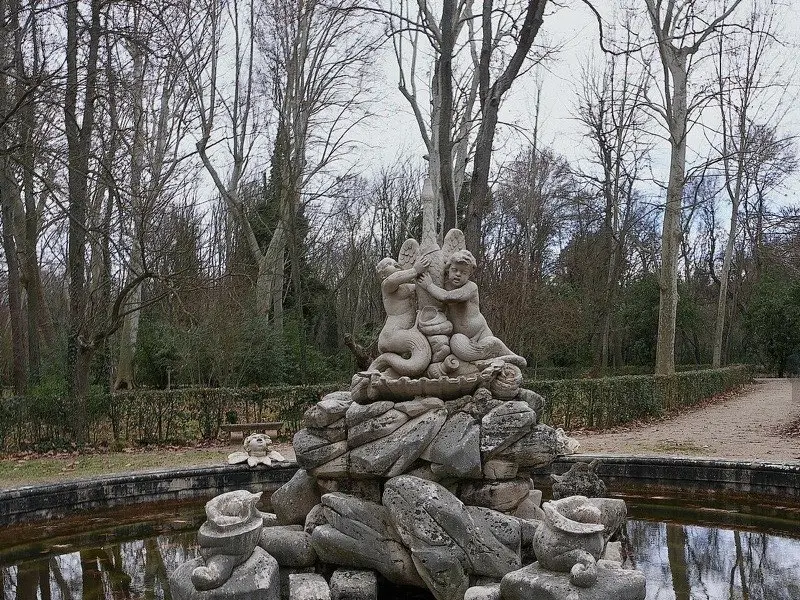
Scattered among the groves, its fountains are genuine open-air sculptures:
- Fountain of Hercules and Antaeus and the Fountain of Venus, among the most photographed.
- Fountain of Apollo, dedicated to the god of the sun and the arts.
- Fountain of Bacchus (wine) and Fountain of Neptune (the sea).
- Clock Fountain and Fountain of the Apothecary, more tucked away.
- The Castanets Cascade, at the entrance beside the palace.
How to visit and tips
- Access is via the Parterre Garden, alongside the palace facade.
- It is a flat and shaded walk: ideal in summer and very comfortable with children or a pushchair.
- Allow at least 45 min–1 hour to explore it at a leisurely pace.
- The light in the early morning and at sunset is best for photos.
Discover it with a guide
A guided tour tells you the history behind every fountain and combines the gardens and palace without queues.
See guided tours →⏳ Time-slot places are limited. Lock in your time · cancellation terms on the product page.